
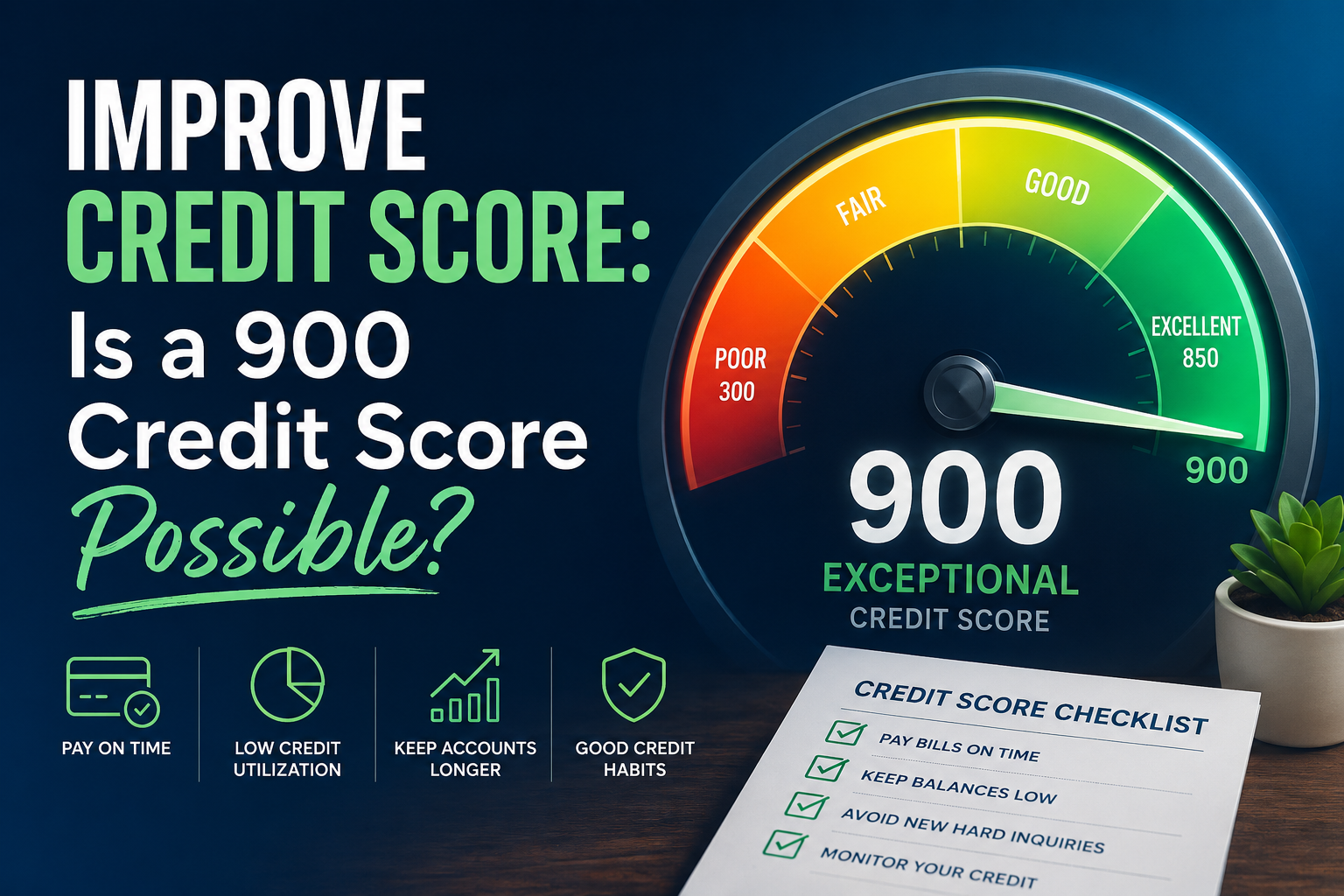
Your credit score can change your financial life. It affects whether you get approved for a loan. It also affects the interest rate you pay. A higher score means better deals.
But here is a question many people ask. Is a 900 credit score even possible? And if it is, can you actually reach it?
Let’s break it all down in simple terms.
What Is a Credit Score?
A credit score is a three-digit number. It tells lenders how responsible you are with money. The most common scoring model is the FICO score.
FICO scores range from 300 to 850. Some newer models go up to 900 or even 950. But the standard range most lenders use tops out at 850.
Here is a quick breakdown of the FICO score ranges:
- 300 to 579 — Poor
- 580 to 669 — Fair
- 670 to 739 — Good
- 740 to 799 — Very Good
- 800 to 850 — Exceptional
So when people talk about a 900 credit score, they usually mean scoring at the very top.
ALSO READ: MyUSFinance Compound Interest Calculator: Grow Your Money Faster in 2026

Is a 900 Credit Score Actually Possible?
This depends on the scoring model being used.
1. The Standard FICO Model
The standard FICO model caps at 850. So a 900 is not possible here. However, an 850 is the perfect score. Very few people ever reach it.
2. Other Scoring Models
Some scoring models do go higher than 850. For example, the FICO Auto Score and FICO Bankcard Score range from 250 to 900. These are used for specific types of loans.
So yes, a 900 credit score is possible. But only on these specialized models. For everyday purposes, 850 is the top.
3. What Lenders Actually Look At
Here is something important. Most lenders do not care if you have an 800 or an 850. Both are treated the same. You will get the best rates either way.
So chasing a perfect 850 or 900 is not always necessary. What matters most is getting into that exceptional range.
Why Your Credit Score Matters?
Your credit score affects more than just loans. It plays a role in many areas of your financial life.
1. Loan Approvals
A higher score means lenders trust you more. You are more likely to get approved for mortgages, car loans, and personal loans.
2. Interest Rates
This is where it really counts. A good score can save you thousands of dollars over time. For example, a lower mortgage rate on a 30-year loan adds up to huge savings.
3. Credit Card Offers
The best credit cards with the highest rewards are reserved for people with good scores. Cash back, travel points, and zero interest offers become available to you.
4. Renting an Apartment
Many landlords check your credit score. A poor score can get your rental application rejected. A good score makes the process smooth.
5. Even Your Job
Some employers check credit scores too. This is especially true for financial or government jobs.
What Makes Up Your Credit Score?
To improve your score, you need to understand what affects it. FICO uses five key factors.
1. Payment History (35%)
This is the biggest factor. It tracks whether you pay your bills on time. Even one late payment can hurt your score significantly.
2. Credit Utilization (30%)
This is how much of your available credit you are using. If your credit limit is $10,000 and you owe $3,000, your utilization is 30%.
Experts recommend keeping it below 30%. The lower, the better.
3. Length of Credit History (15%)
The longer your credit history, the better. This is why it helps to keep old accounts open. Closing them can shorten your history.
4. Credit Mix (10%)
Lenders like to see that you can handle different types of credit. This includes credit cards, car loans, and mortgages.
5. New Credit Inquiries (10%)
Every time you apply for new credit, a hard inquiry is added to your report. Too many inquiries in a short time can lower your score.
How to Improve Your Credit Score?
Now let’s get to the part that matters most. Here are the most effective ways to improve your credit score.
1. Pay Every Bill on Time
This is the single most important step. Payment history makes up 35% of your score.
Set up automatic payments. Use reminders on your phone. Do whatever it takes to never miss a due date.
Even one missed payment can stay on your report for up to seven years. That is a long time to deal with the consequences.
2. Lower Your Credit Utilization
Keep your balances low. Try to use less than 30% of your credit limit. If you can get it below 10%, even better.
Here are two ways to do this. First, pay down your existing balances. Second, ask your credit card company to increase your credit limit. This automatically lowers your utilization ratio.
3. Do Not Close Old Accounts
It might feel good to close a card you no longer use. But this can actually hurt your score. Closing an old account shortens your credit history.
Keep old accounts open. Even if you only use them occasionally. It helps your score stay healthy.
4. Limit New Credit Applications
Every time you apply for a new credit card or loan, your score takes a small hit. It is called a hard inquiry.
Do not apply for multiple cards at once. Space out your applications. Only apply when you truly need new credit.
5. Check Your Credit Report for Errors
Mistakes on your credit report are more common than you think. A wrong account, a false late payment, or an identity theft issue can drag your score down.
Check your report at least once a year. In the US, you can get free reports from all three bureaus at AnnualCreditReport.com.
If you find an error, dispute it right away. Getting it removed can boost your score quickly.6.
6. Become an Authorized User
Ask a family member or close friend with good credit to add you as an authorized user on their card. Their positive payment history can reflect on your credit report too.
This is one of the fastest ways to build or boost your score.
7. Use a Secured Credit Card
If you are just starting out or rebuilding your credit, a secured card is a great tool. You deposit money as collateral. Then you use the card like a regular credit card.
Over time, responsible use builds a positive credit history.
8. Pay Down Debt Strategically
Having a lot of debt hurts your utilization rate. Focus on paying off high-balance credit cards first.
The snowball and avalanche methods are both popular strategies. The snowball method pays off the smallest debts first. The avalanche method tackles the highest interest debts first.
Either way, reducing your total debt helps your score climb.
How Long Does It Take to Improve Your Credit Score?
There is no exact timeline. It depends on where you are starting from.
Small improvements can happen within 30 to 60 days. This is especially true if you lower your credit utilization quickly.
Building from a poor score to an exceptional score can take a few years. But with consistent habits, it is very much achievable.
Here is a rough estimate:
- Fixing an error on your report — A few weeks
- Lowering utilization — 1 to 2 months
- Recovering from a late payment — 12 to 24 months
- Rebuilding from bankruptcy — 3 to 7 years
Patience and consistency are your two best tools.
What Score Should You Actually Aim For?
You do not need a perfect score to enjoy the best financial benefits. Anything above 760 to 800 is considered excellent by most lenders.
At that level, you qualify for the best interest rates. You get approved for top credit cards. You have access to the best loan offers.
Of course, shooting for the highest score possible is never a bad idea. It builds strong financial habits. And it gives you a buffer in case something unexpected happens.
ALSO READ: MyUSFinance Compound Interest Calculator: Grow Your Money Faster in 2026
Final Thoughts
A 900 credit score is possible, but only on certain scoring models. On the standard FICO scale, 850 is the perfect score.
The good news is that you do not need a perfect score to win financially. Getting into the 750 to 850 range is more than enough.
Focus on paying on time. Keep your balances low. Avoid unnecessary credit applications. Check your report regularly for errors.
These habits are simple. But they are powerful. Over time, they will move your score in the right direction.
Your credit score is not fixed. It changes with your habits. Start improving those habits today. The results will follow.