
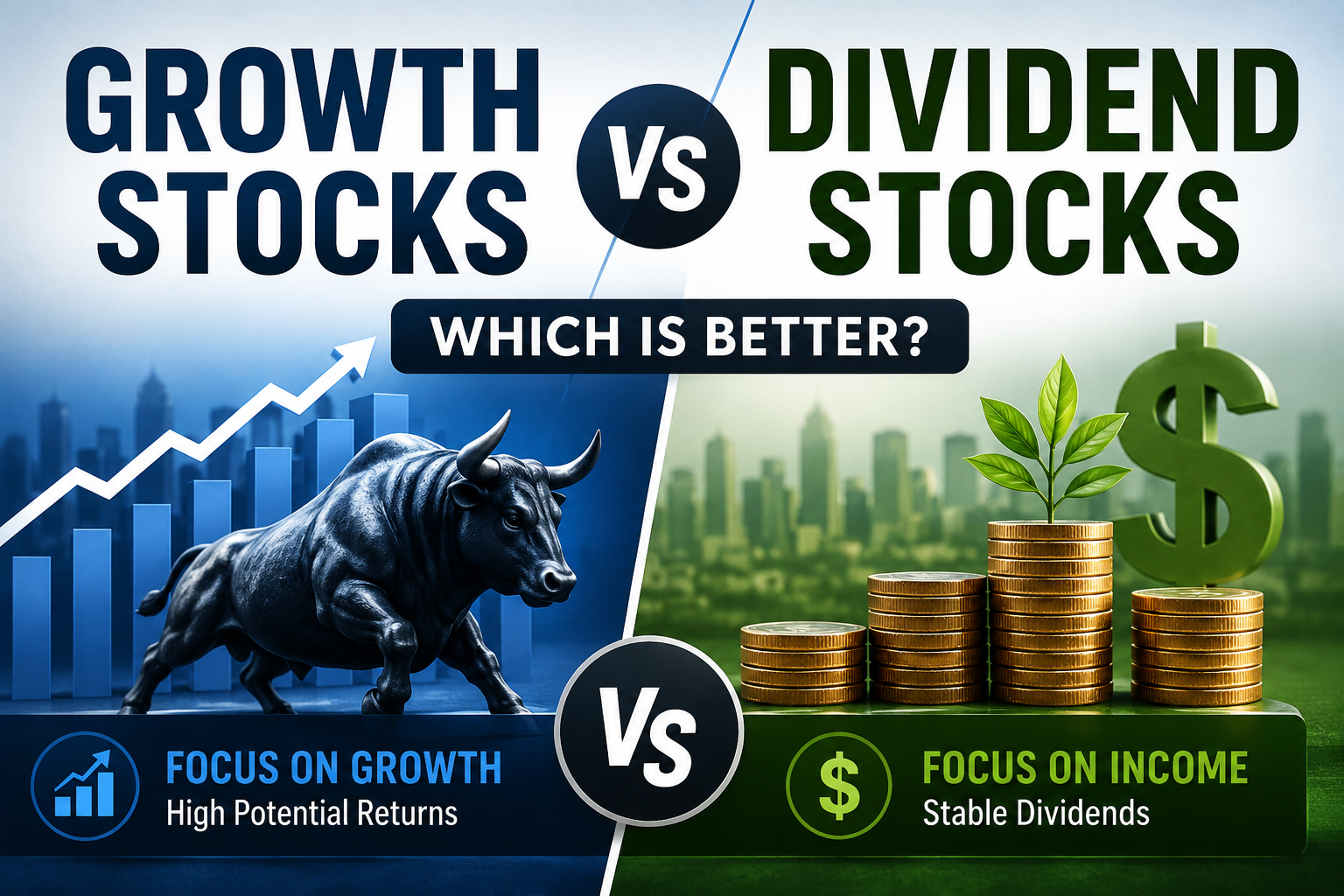
If you have ever tried to research investing, you have probably come across these two terms. Growth stocks. Dividend stocks. People argue about which one is better all the time.
But here is the truth. There is no single right answer. The better choice depends on who you are, what you want, and where you are in your financial journey.
This article is going to break it all down for you. No confusing financial jargon. Just simple, honest information you can actually use.

What Are Growth Stocks?
Growth stocks are shares in companies that are expected to grow faster than average. These companies usually reinvest all their profits back into the business. They use that money to expand, hire more people, build new products, or enter new markets.
Think of companies like Amazon, Tesla, or Nvidia in their earlier years. They were not paying dividends. They were putting every dollar back into growing the business.
That is the core idea behind a growth stock. The company is focused on getting bigger. And as it gets bigger, the stock price goes up. That is how you make money with growth stocks. You buy early and sell later at a higher price.
How Growth Stocks Make You Money?
With growth stocks, you make money through capital gains. That means the value of your shares increases over time. You buy at $50 and sell at $200. The difference is your profit.
But there is a catch. You only make money when you sell. Until then, it is all on paper. And if the stock drops before you sell, your gains can disappear fast.
Who Typically Invests in Growth Stocks?
Growth stocks tend to attract younger investors. People who have time on their side. If you are in your 20s or 30s, you can afford to ride out the ups and downs of a volatile growth stock.
They also attract people who do not need income from their investments right now. You are playing the long game. You want your money to multiply, not pay you a monthly check.
ALSO READ: Dollar Cost Averaging Explained: A Beginner’s Guide to Smarter Investing
What Are Dividend Stocks?
Dividend stocks are shares in companies that pay their shareholders a portion of their profits on a regular basis. That payment is called a dividend.
These are usually older, more established companies. Think Coca-Cola, Johnson and Johnson, or Procter and Gamble. They have been around for decades. They are not going to triple in size overnight. But they are steady, reliable, and they share their profits with you regularly.
Dividends are usually paid quarterly. Some companies pay monthly. The amount you receive depends on how many shares you own and the dividend yield of the stock.
How Dividend Stocks Make You Money?
Dividend stocks give you two ways to make money. First, you collect dividend payments regularly. Second, the stock price can still go up over time, giving you capital gains too.
The dividend yield tells you how much a company pays out relative to its stock price. For example, if a stock is priced at $100 and pays $4 per year in dividends, the yield is 4%.
Over time, if you reinvest your dividends back into buying more shares, the compounding effect becomes very powerful.
Who Typically Invests in Dividend Stocks?
Dividend stocks are popular with people who want passive income. Retirees love them because dividends provide a regular cash flow without having to sell any shares.
They also appeal to more conservative investors. People who want less risk and more stability in their portfolio.
Growth Stocks vs Dividend Stocks: The Key Differences
Let’s put them side by side so you can see exactly how they compare.
| Feature | Growth Stocks | Dividend Stocks |
|---|---|---|
| How you earn | Capital gains | Dividends + capital gains |
| Risk level | Higher | Lower |
| Best for | Long term wealth building | Passive income |
| Volatility | High | Low to moderate |
| Ideal investor | Young, patient investors | Income seekers, retirees |
| Reinvestment | Company reinvests profits | You receive profits |
| Examples | Tesla, Nvidia, Shopify | Coca-Cola, Johnson and Johnson |
The Case for Growth Stocks
1. Higher Potential Returns
Growth stocks have the potential to deliver massive returns. If you had bought Amazon stock in 2010, you would have seen gains of over 3,000% by 2020. That kind of return is simply not possible with most dividend stocks.
For young investors with a long time horizon, that growth potential is hard to ignore.
2. You Control When You Pay Taxes
With growth stocks, you only owe taxes when you sell. That means you can let your investment grow for years or even decades without triggering a tax event. That is a significant advantage over dividends, which are taxed every year you receive them.
3. Great for Long Term Wealth Building
If your goal is to build a large amount of wealth over 20 or 30 years, growth stocks can be a powerful tool. Time and compounding work in your favor.
The Case for Dividend Stocks
1. You Get Paid While You Wait
One of the best things about dividend stocks is that you do not have to sell anything to make money. The company sends you a check regularly just for owning shares.
That regular income can be used to cover expenses, reinvested to buy more shares, or saved for something else entirely. It gives you flexibility.
2. Less Volatility and More Stability
Dividend stocks tend to be less volatile than growth stocks. Established companies like Coca-Cola do not swing wildly in price. That stability can be comforting, especially when the broader market is having a rough stretch.
3. Dividend Growth Over Time
Many companies increase their dividends every single year. These are called dividend growth stocks. Companies like Johnson and Johnson have raised their dividend for over 60 consecutive years.
That means your income from dividends keeps going up even if you do not invest another dollar.
4. Reinvesting Dividends Is Incredibly Powerful
When you reinvest your dividends automatically through a DRIP (Dividend Reinvestment Plan), you buy more shares with every payment. Those new shares earn more dividends. Those dividends buy even more shares. The compounding effect over 20 or 30 years is remarkable.
The Risks You Need to Know About
i. Risks of Growth Stocks
Growth stocks can be unpredictable. A company that looks unstoppable today can struggle tomorrow. If the company fails to meet growth expectations, the stock can drop sharply and fast.
Growth stocks are also more sensitive to interest rate changes and economic downturns. During a recession, high growth companies often take the biggest hit.
You also have no income from dividends to cushion the blow if prices fall. You are fully dependent on the stock price going up.
ii. Risks of Dividend Stocks
Dividend stocks are not risk free either. A company can cut or eliminate its dividend if it runs into financial trouble. When that happens, the stock price usually drops too. That is a double hit.
Dividend stocks also tend to grow more slowly. If you are chasing massive wealth accumulation, slow and steady growth might not get you there fast enough.
Inflation is another concern. If your dividend yield is 3% but inflation is running at 4%, your real purchasing power is actually shrinking.

Which One Is Better for You?
Here is an honest breakdown based on your situation.
You Should Consider Growth Stocks If:
You are young and have at least 10 to 15 years before you need the money. You are comfortable with volatility and can handle seeing your portfolio drop without panicking. You do not need income from your investments right now. You want to build maximum wealth over the long term.
You Should Consider Dividend Stocks If:
You want regular passive income from your investments. You are closer to retirement or already retired. You prefer stability over high risk high reward situations. You want to reinvest dividends and let compounding do the heavy lifting over time.
The Best Answer: You Do Not Have to Choose Just One
Most smart investors do not put everything into one category. They build a portfolio that has both.
You might put 70% into growth stocks while you are young and building wealth. Then gradually shift toward dividend stocks as you get closer to retirement and want more income and stability.
That balance gives you the best of both worlds.
A Simple Way to Get Started With Both
You do not need to pick individual stocks to get exposure to both categories. There are funds designed specifically for each.
For growth exposure, consider funds like the Vanguard Growth ETF (VUG) or QQQ which tracks the Nasdaq 100.
For dividend exposure, consider funds like the Vanguard Dividend Appreciation ETF (VIG) or the Schwab U.S. Dividend Equity ETF (SCHD).
These funds give you instant diversification without having to research and pick individual companies yourself.
ALSO READ: How to Make Money as a College Student?
Final Thoughts
Growth stocks and dividend stocks are both solid tools for building wealth. They just work differently and serve different purposes.
Growth stocks are for people who want to maximize their returns over time and do not need income right now. Dividend stocks are for people who want steady income and less stress along the way.
The smartest move is to understand what you want from your investments and build a mix that fits your goals, your timeline, and your comfort with risk.
Start with what makes sense for where you are right now. Adjust as your life changes. And most importantly, just get started.