
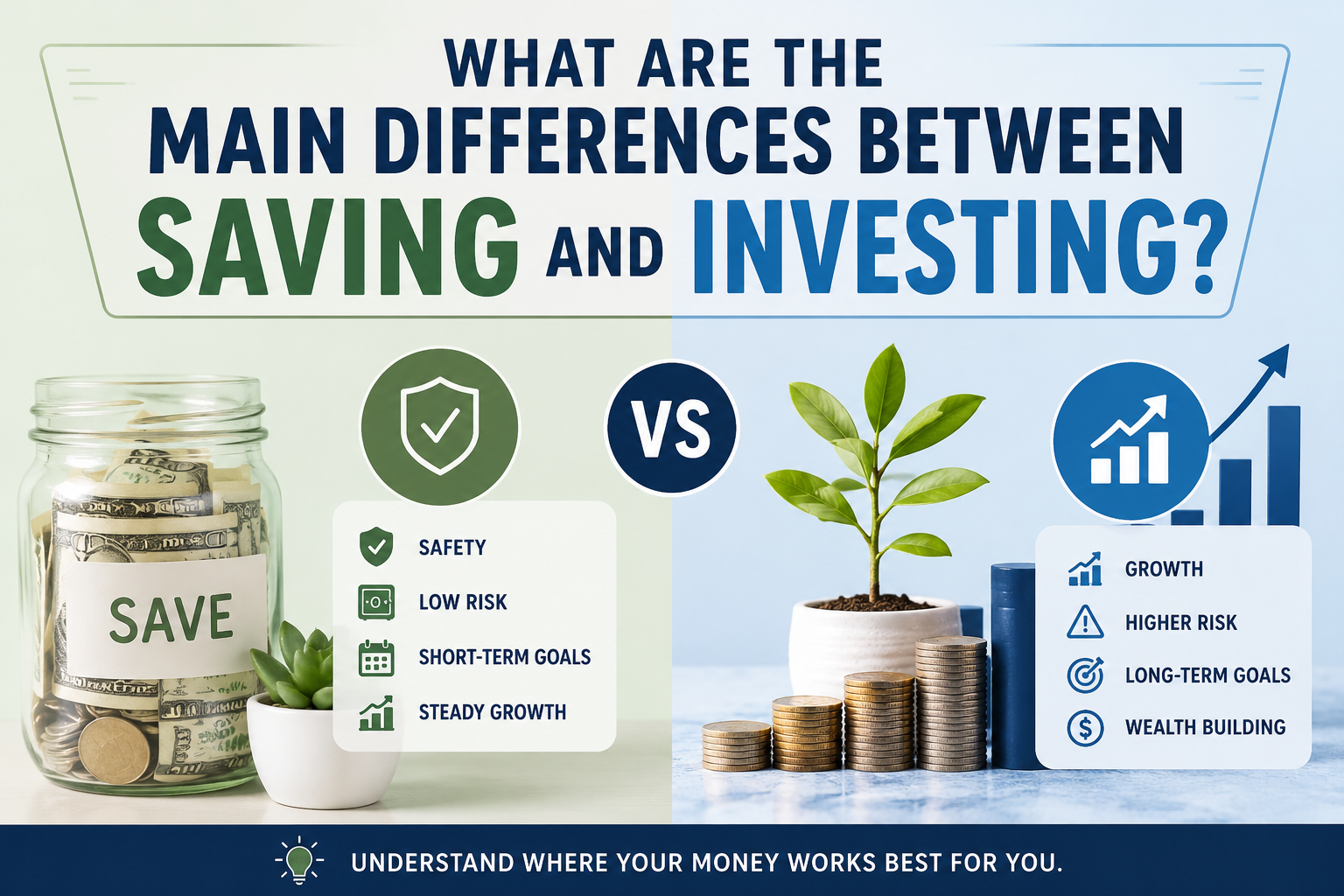
If you are just starting your financial journey, you have probably heard two pieces of advice more than anything else.
Save your money.
And invest your money.
But here is the thing. Saving and investing are not the same thing. They work differently. They serve different purposes. And using the wrong one at the wrong time can actually slow down your financial progress.
This guide breaks it all down in simple terms so you know exactly when to save, when to invest, and how to use both together.
ALSO READ: High Yield Investments: 12 Best Options to Grow Your Money in 2026

What Is Saving?
Saving means setting aside money you do not spend. You keep it somewhere safe and easy to access. The goal is to protect your money, not grow it.
Most people save in a bank account. This could be a regular savings account, a high-yield savings account, or a money market account.
Your money earns a little interest. But the primary purpose is safety and availability.
Key Features of Saving
It is low risk. Your money is not exposed to market swings. What you put in stays there.
It is liquid. You can access your money whenever you need it. No waiting, no selling.
It earns low returns. Interest rates on savings accounts are typically between 1% and 5%. That is far lower than what investing can offer over time.
It is insured. Bank deposits in Pakistan and most countries are protected up to a certain limit. In the US, FDIC insurance covers up to $250,000.
What Is Investing?
Investing means putting your money to work so it can grow over time. You buy an asset, such as stocks, mutual funds, real estate, or ETFs. The goal is to build wealth.
The key difference is that investing involves risk. Your money can go up. It can also go down. But historically, patient investors have been rewarded with returns that far outpace savings accounts.
Key Features of Investing
It carries risk. Markets go up and down. There is no guarantee your investment will grow.
It offers higher returns. The stock market has historically averaged around 7% to 10% per year over the long term. That is significantly more than any savings account.
It is less liquid. Some investments take time to sell. Others have lock-in periods. You cannot always access your money instantly.
It builds long-term wealth. This is where real financial growth happens. Compound returns over years and decades can turn modest contributions into significant wealth.
Saving vs Investing: The Main Differences at a Glance
| Feature | Saving | Investing |
|---|---|---|
| Purpose | Safety and short-term needs | Long-term wealth growth |
| Risk Level | Very low | Low to high |
| Returns | Low (1% to 5%) | Higher (7% to 10% avg.) |
| Liquidity | High (easy to access) | Varies |
| Time Horizon | Short term | Long term |
| Best For | Emergency fund, near goals | Retirement, wealth building |
Why You Need Both?
Here is a mistake many beginners make. They treat saving and investing as an either/or choice.
They are not. You need both.
Saving gives you a financial safety net. Investing gives you financial growth. One protects you. The other builds your future.
Think of it this way. Saving is your defense. Investing is your offense. A good team needs both.
When Should You Save?
Saving makes sense in specific situations. Here are the most important ones.
1. You Are Building an Emergency Fund
This is the number one priority before you invest a single rupee or dollar.
Your emergency fund should cover 3 to 6 months of living expenses. Keep it in a savings account. Do not invest it. You need to be able to access it quickly if something goes wrong.
2. You Have a Short-Term Goal
Planning to buy a car in one year? Saving for a wedding or a vacation? Save for it.
Investing for goals under 3 years is risky. Markets can drop right when you need the money. A savings account protects you from that.
3. You Cannot Afford to Lose the Money
If losing this money would cause a serious problem, do not invest it. Keep it in savings where it is safe.
When Should You Invest?
Once your emergency fund is in place, investing becomes your next move.
1. You Are Building for Retirement
Retirement is the most powerful reason to invest. Time is your biggest advantage here. The earlier you start, the more your money compounds.
Even small amounts invested consistently grow into something significant over 20 to 30 years.
2. You Have a Long-Term Goal (5+ Years)
Saving for your child’s education 10 years from now? Building wealth for the future? Invest it.
The longer your time horizon, the more risk you can afford to take. Short-term market dips matter less when you have decades ahead.
3. You Want to Beat Inflation
This is a big one that beginners often overlook.
Inflation quietly eats away at your savings. If inflation is 5% and your savings account earns 2%, you are actually losing purchasing power. Investing helps your money outpace inflation over time.
The Role of Risk in Saving and Investing
Risk is the clearest line between the two.
Saving has almost no risk. Your money is safe. The downside? It barely grows.
Investing has real risk. Your portfolio can lose value. But over long periods, that risk is rewarded with much higher returns.
How to Think About Risk?
Your risk tolerance depends on a few things.
i. Time horizon. The more time you have, the more risk you can take. A 25-year-old investing for retirement can ride out market dips.
ii. Financial situation. If you have no emergency fund and no stable income, now is not the time to take big investment risks.
iii. Emotional comfort. Some people cannot sleep when their portfolio drops 20%. That is okay. Choose investments that match your comfort level.
How Returns Compare Over Time?
Let us look at a simple example.
Imagine you have $5,000 today.
If you keep it in a savings account earning 3% per year, after 20 years you would have around $9,030.
If you invest it and earn 8% per year on average, after 20 years you would have around $23,300.
That is more than double the result. And the difference grows even more dramatically over 30 or 40 years.
This is why investing matters for long-term wealth. Saving alone is not enough.
Common Mistakes Beginners Make
Mistake 1: Only Saving, Never Investing
Many people feel safer keeping everything in a savings account. It feels secure. But over time, inflation erodes that safety. Your money loses purchasing power while sitting still.
Mistake 2: Investing Before Building an Emergency Fund
This is equally dangerous. If your car breaks down or you lose your job, and all your money is tied up in stocks, you may have to sell at a loss just to cover expenses.
Always build your emergency fund first.
Mistake 3: Treating Investing Like Gambling
Investing is not gambling when done properly. Putting money into a diversified index fund and holding it for 20 years is not gambling. It is patient, strategic wealth building.
Mistake 4: Waiting for the Perfect Time to Invest
There is no perfect time. The stock market will always feel risky. The best move is to start with what you have, as early as you can, and stay consistent.
A Simple Framework for Young Adults
If you are just starting out, here is a simple order to follow.
Step 1. Build a small starter emergency fund of around $500 to $1,000.
Step 2. Pay off any high-interest debt. Credit card debt at 20% interest is worse than any investment return.
Step 3. Build your full emergency fund. Aim for 3 to 6 months of expenses.
Step 4. Start investing. Even $25 or $50 per month matters. Start small and build the habit.
Step 5. Increase your contributions over time as your income grows.

Where to Start Saving?
A high-yield savings account is your best bet for holding your savings. These accounts offer better interest rates than traditional banks.
Look for accounts with no monthly fees, easy online access, and FDIC or local equivalent insurance. Keep it separate from your checking account so you are not tempted to spend it.
Where to Start Investing?
For beginners, the simplest starting point is a low-cost index fund or ETF.
These funds spread your money across hundreds of companies automatically. You get broad diversification without needing to pick individual stocks.
Some popular options for beginners include S&P 500 index funds, which track the 500 largest US companies. They have historically delivered solid long-term returns with low fees.
You do not need a lot of money to start. Many platforms let you begin with as little as $1.
ALSO READ: Money Saving Box: What It Is and How to Use It to Save More?
Final Thoughts
Saving and investing are both essential. But they serve very different purposes.
Save for safety. Save for the short term. Save so you have a cushion when life gets unpredictable.
Invest for growth. Invest for the long term. Invest so your money works harder than you do.
The goal is to use both together smartly. Build your safety net first. Then put your money to work.
The sooner you understand this difference, the better position you will be in to build real, lasting wealth.
Start with what you have. Stay consistent. Keep learning.