
Investing can feel scary when you are just starting out. You might wonder: “What if I invest all my money and the market crashes tomorrow?”
That fear is real. And it stops a lot of people from ever getting started.
But there is a simple strategy that takes the guesswork out of investing. It is called dollar cost averaging.
And once you understand it, you will never look at investing the same way again.
What Is Dollar Cost Averaging?
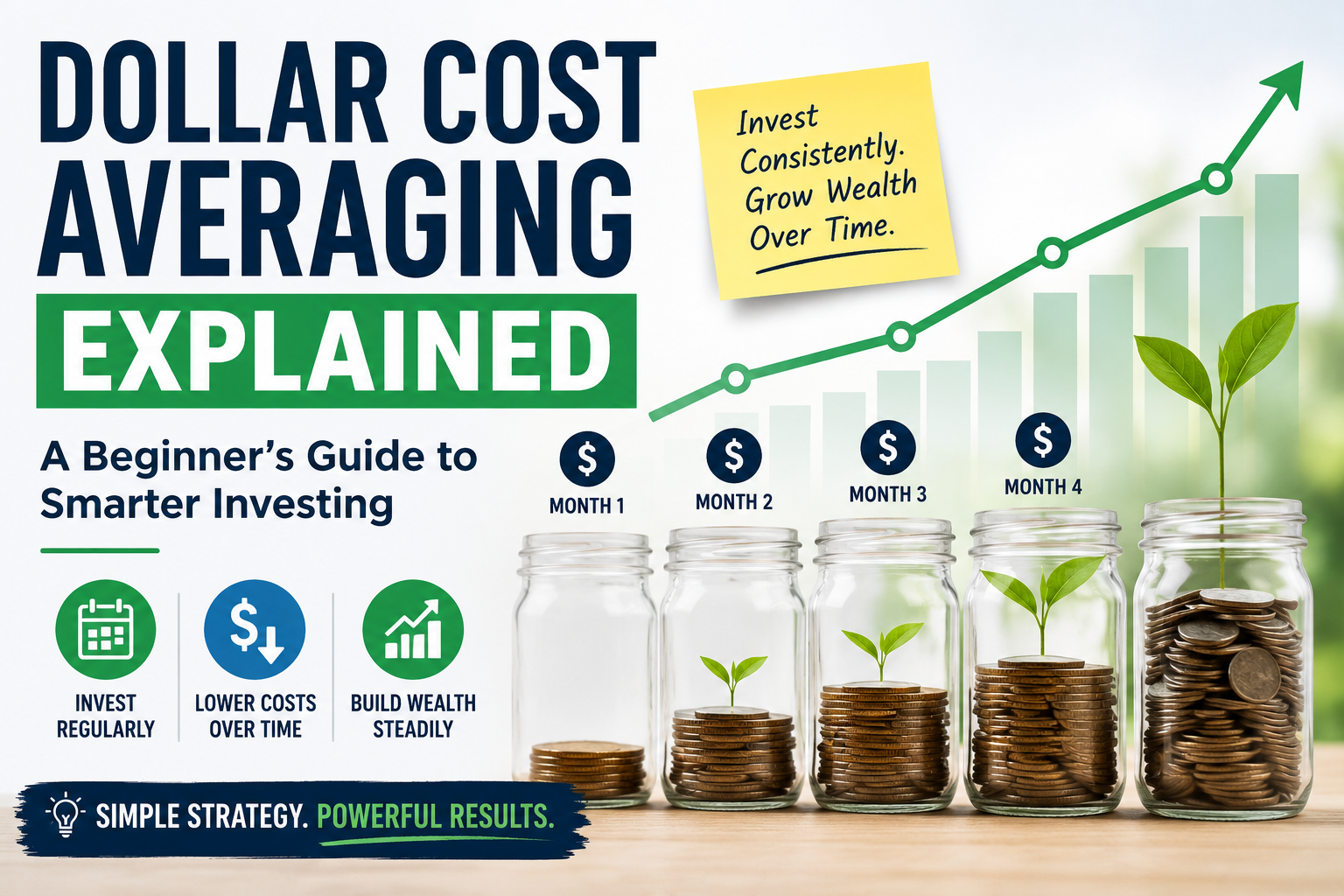
Dollar cost averaging (DCA) is when you invest a fixed amount of money at regular intervals. Instead of trying to time the market, you just keep investing consistently. Every week. Every month. No matter what the market is doing.
For example, let’s say you invest $100 every month into an S&P 500 index fund. Some months the market is up. Some months it is down. But you keep investing regardless.
That consistency is the whole point.
The term “dollar cost averaging” comes from the idea that over time, you end up buying shares at different prices. Sometimes you buy high. Sometimes you buy low. It all averages out over time.
ALSO READ: How to Calculate Cash Received from Dividends?

How Does Dollar Cost Averaging Work?
Let’s break it down with a simple example.
Imagine you invest $200 every month into a stock. Here is what that might look like over four months:
| Month | Amount Invested | Share Price | Shares Bought |
|---|---|---|---|
| January | $200 | $20 | 10 shares |
| February | $200 | $10 | 20 shares |
| March | $200 | $25 | 8 shares |
| April | $200 | $16 | 12.5 shares |
After four months, you invested $800 total. You now own 50.5 shares. Your average cost per share is around $15.84.
Notice what happened in February. The market dropped and the price fell to $10. That scared a lot of investors. But because you kept investing, you bought 20 shares that month instead of 10. When the price recovered, those cheap shares gained more value.
That is the power of dollar cost averaging at work.
Why Dollar Cost Averaging Is Smart for Beginners?
1. You Stop Trying to Time the Market
Most people think smart investing means buying at the perfect low and selling at the perfect high. But even professional investors cannot do that consistently.
Trying to time the market leads to two bad habits. You either wait too long to buy. Or you panic and sell when prices drop.
Dollar cost averaging removes both of those problems. You invest on a schedule. The market’s short term moves stop mattering as much.
2. It Removes Emotional Decision Making
Your emotions are your biggest enemy when it comes to investing. Fear makes you sell at the worst time. Greed makes you buy when prices are already too high.
DCA builds a routine. You invest the same amount on the same day every month. There is no room for panic or FOMO to creep in.
3. You Do Not Need a Lot of Money to Start
One of the best things about dollar cost averaging is that you can start small. You do not need thousands of dollars saved up before you begin.
Even $25 or $50 a month adds up over time. What matters is that you start and stay consistent. Time in the market beats timing the market every single time.
4. It Works With Your Budget
You know exactly how much you are investing each period. That makes budgeting simple and predictable. You can plan around it like any other monthly expense.
Dollar Cost Averaging vs. Lump Sum Investing
You might be wondering: what if I have a large amount of money to invest? Should I put it all in at once or spread it out?
This is a common question. And the honest answer is: it depends.
When Lump Sum Wins?
Research has shown that lump sum investing often outperforms DCA over the long run. The reason is simple. Money invested earlier has more time to grow. If the market trends upward over time (which it historically has), getting your money in early gives it more time to compound.
When Dollar Cost Averaging Wins?
But here is the thing. Most beginners do not have a large lump sum sitting around. They are investing from their monthly paycheck. DCA fits that reality perfectly.
DCA also wins when it comes to protecting you emotionally. Investing a large chunk of money right before a market crash feels terrible. DCA spreads out that risk. Even if the market drops after your first investment, your future contributions will be buying in at lower prices.
For most beginners and young investors, DCA is the more practical and emotionally sustainable choice.
How to Start Dollar Cost Averaging?
Step 1: Choose What You Want to Invest In
For beginners, low cost index funds and ETFs are usually the best starting point. Something like the Vanguard S&P 500 ETF (VOO) or a total stock market index fund gives you broad diversification.
You do not need to pick individual stocks to start. Keep it simple.
Step 2: Decide How Much You Can Invest Each Month
Look at your budget honestly. What can you consistently set aside without hurting your everyday expenses? Even if it is $30 a month, that is a great start.
The key word is consistently. It is better to invest $50 every month than to invest $500 once and then stop.
Step 3: Set a Regular Schedule
Pick a date and stick to it. A lot of people align their investments with their payday. When your paycheck hits, a set amount automatically goes toward investing.
Out of sight, out of mind. You will not miss what you never had in your spending account.
Step 4: Automate It
Most brokerage platforms let you set up automatic investments. Apps like Fidelity, Charles Schwab, and even Robinhood make this easy.
Automation is the secret weapon of DCA. When investing is automatic, you cannot forget. And you cannot talk yourself out of it during a rough market week.
Step 5: Stay Consistent No Matter What
This is the hardest step for most people. When the market drops 20%, everything in you will want to stop investing or pull your money out.
Do not. A market dip is not a reason to stop. It is actually a reason to keep going. You are buying more shares at a lower price.
Common Mistakes to Avoid With Dollar Cost Averaging
1. Stopping During Market Downturns
This is the most common mistake. People invest consistently until the market drops. Then they panic and stop.
That is the opposite of what you should do. Market downturns are when DCA works best for you. Lower prices mean more shares for the same dollar amount.
2. Choosing the Wrong Investment
DCA does not make a bad investment good. If you are putting $100 every month into a single risky stock that eventually goes to zero, DCA will not save you.
Stick to diversified index funds or ETFs. That way, you are spreading your risk across hundreds of companies.
3. Investing Money You Might Need Soon
Dollar cost averaging is a long term strategy. Do not invest money that you might need in the next one to three years.
Build your emergency fund first. Then invest what you can truly leave alone for several years.
Is Dollar Cost Averaging Right for You?
If you are a beginner who is just starting to invest, yes. Dollar cost averaging is one of the best strategies you can use.
It is simple. It is consistent. And it removes a lot of the stress that comes with trying to figure out the “right time” to invest.
You do not need to be a financial expert to use it. You just need discipline and patience.
The best investors are not the ones who make the cleverest moves. They are the ones who show up consistently over many years.
ALSO READ: 10 Powerful Money Habits of Successful People
Final Thoughts
Dollar cost averaging will not make you rich overnight. Nothing will. But it will build your wealth steadily over time, without requiring you to predict the market or have a large amount of money upfront.
Start small. Stay consistent. Let time do the heavy lifting.
The best day to start investing was yesterday. The second best day is today.