
Most people know they should be saving money. But very few understand the one force that turns small savings into serious wealth over time.
That force is compound interest.
And if you have ever searched for a simple way to calculate it, you have probably come across MyUSFinance.
It is one of the most beginner-friendly financial tools available online today.
This article will explain what compound interest is, how the MyUSFinance compound interest calculator works, and why starting early can change your entire financial future.
What Is Compound Interest?
Let’s start from the very beginning.
Compound interest is when you earn interest not just on the money you put in, but also on the interest you already earned. It is interest on top of interest. Over time, this creates a snowball effect.
Here is a simple example.
You put $1,000 in a savings account. It earns 5% interest in the first year. You now have $1,050. In the second year, you earn 5% on $1,050, not on the original $1,000. So now you have $1,102.50.
That extra $2.50 does not sound exciting. But stretch that out over 20 or 30 years, and the numbers become genuinely life-changing.
Simple Interest vs Compound Interest
Simple interest is straightforward. You earn a fixed percentage on your original deposit only. Every year you earn the same amount.
Compound interest is different. Your interest earns interest. Your growth accelerates over time. The longer you leave your money alone, the faster it grows.
This is why compound interest is often called the eighth wonder of the world.
ALSO READ: Caitlin Clark Net Worth 2026: How She Built a $20 Million Fortune

What Is MyUSFinance?
MyUSFinance is a website offering over 110 free financial calculators and 100 expert guides for Americans. It covers budgeting, mortgage, investment, retirement, tax, loan, and insurance tools with no signup required and no data stored.
It is built for everyday people. You do not need a finance degree to use it. You just enter your numbers and get clear results immediately.
Financial calculators like the ones on MyUSFinance transform abstract concepts like compound interest, amortization, and tax liability into concrete numbers you can actually act on.
For beginners especially, this kind of tool is powerful. It takes the guesswork out of financial planning.
How the MyUSFinance Compound Interest Calculator Works?
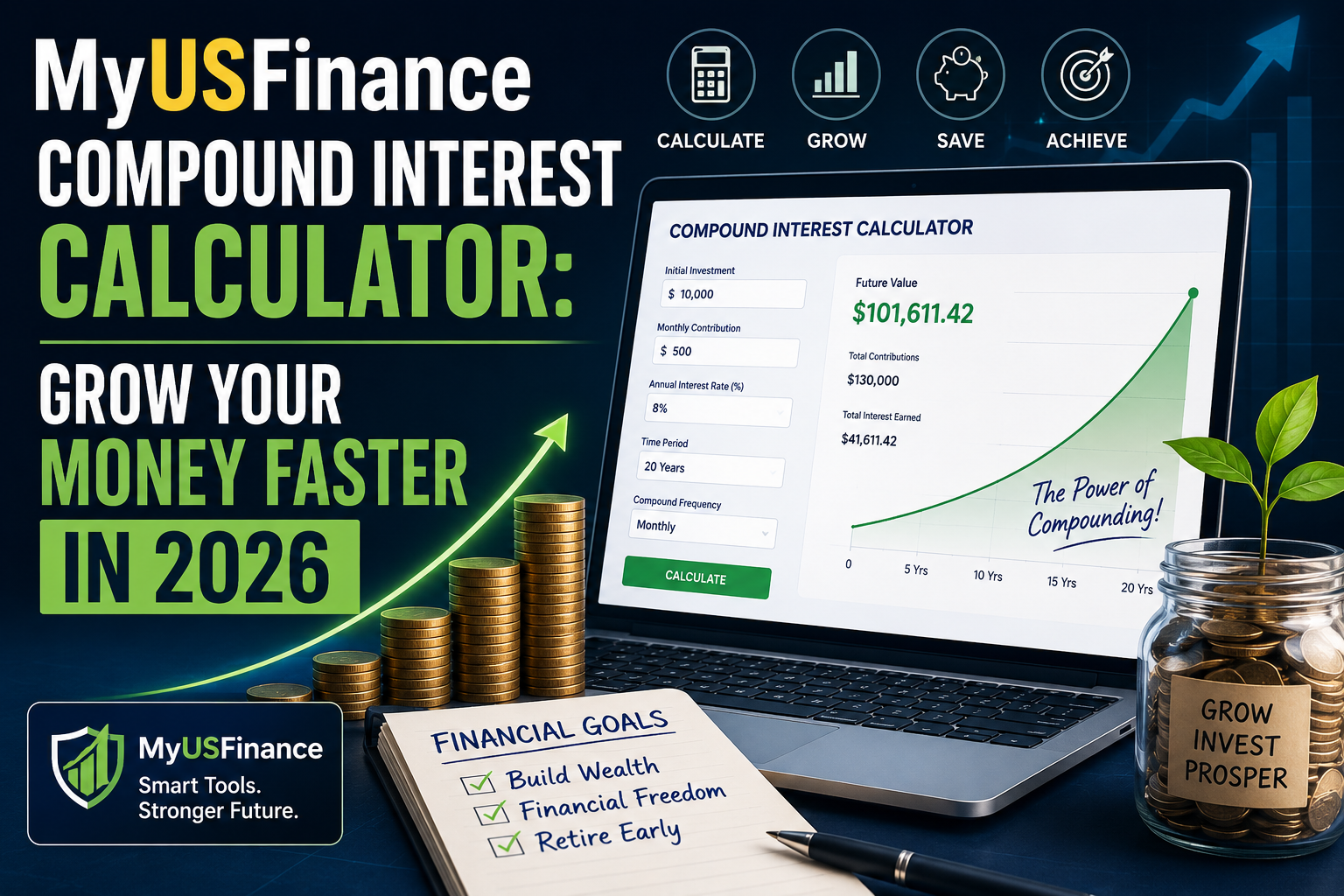
Using the MyUSFinance compound interest calculator is simple. You do not need any prior financial knowledge.
Here is what you typically enter:
i. Starting Amount: This is your initial deposit or investment. It could be $100 or $100,000. Whatever you are starting with.
ii. Monthly Contribution: This is how much extra you plan to add each month. Even $50 a month makes a huge difference over time.
iii. Annual Interest Rate: This is the rate your money earns per year. High-yield savings accounts today offer around 4% to 5%. Index funds historically average around 7% to 10% annually.
iv. Time Period: This is how many years you plan to let your money grow. The longer the better.
v. Compounding Frequency: This is how often your interest gets calculated and added back in. Options usually include daily, monthly, quarterly, or yearly. More frequent compounding means slightly faster growth.
Once you enter these details, the calculator shows your future balance instantly. It also shows the total amount you contributed versus how much came purely from interest.
That breakdown is eye-opening for most beginners.
A Real World Example Using the Calculator
Let’s make this concrete.
Say you are 22 years old. You invest $2,000 today. You add $200 every month. Your account earns 7% annually, compounded monthly. You plan to leave it alone for 40 years.
By age 62, your total contributions would be around $98,000. But your account balance? Over $560,000.
That extra $460,000 came purely from compound interest. You did not work for it. Time worked for it.
Now run the same numbers but start at age 32 instead. Same contributions, same interest rate, but only 30 years instead of 40.
Your balance at 62 would be around $243,000. That is less than half.
Those 10 years made a difference of over $300,000. This is why starting early matters so much.
Why Compounding Frequency Matters?
Not all compound interest is created equal.
Daily compounding grows your money slightly faster than monthly compounding. Monthly is faster than quarterly. Quarterly is faster than yearly.
Here is a quick comparison on $10,000 at 5% for 10 years:
Compounded yearly: roughly $16,289
Compounded monthly: roughly $16,470
Compounded daily: roughly $16,487
The differences look small in the short term. But on larger amounts over longer time periods, daily compounding pulls noticeably ahead.
When comparing savings accounts or investment products, always check how often they compound. It matters more than most people realize.
Where Compound Interest Actually Works for You?
Compound interest is not just a calculator concept. It shows up in real financial products you can use right now.
1. High-Yield Savings Accounts
These accounts pay much more than a regular bank savings account. Many currently offer between 4% and 5% APY. Your interest compounds daily or monthly. The more you deposit and the longer you leave it, the more you earn.
2. Index Funds and ETFs
When you invest in an index fund, your returns compound over time. Dividends get reinvested. Your portfolio grows on top of itself. Historically, broad market index funds have returned around 7% to 10% annually after inflation.
3. Roth IRA and 401(k) Accounts
These retirement accounts allow your money to grow tax-free or tax-deferred. Compound interest works even harder here because you are not losing a cut to taxes every year. MyUSFinance recommends contributing enough to get your employer’s 401(k) match first, then considering a Roth IRA.
4. Certificates of Deposit
CDs lock in a fixed interest rate for a set period. They are safe and predictable. The interest compounds over the term. They work well for money you do not need to touch for a year or more.
The Dark Side: Compound Interest Working Against You
Here is the part most finance articles skip.
Compound interest works both ways. On savings and investments, it works for you. On debt, it works against you.
Credit card debt is the biggest example. Most credit cards charge between 20% and 30% APR. If you carry a balance, interest compounds every month on the unpaid balance plus previous interest.
A $3,000 credit card balance at 24% APR with minimum payments can take over 10 years to pay off. You end up paying thousands more than you originally borrowed.
This is why paying off high-interest debt before investing aggressively is such standard financial advice. MyUSFinance even highlights focusing on credit card balances and personal loans first as a core step in any financial plan.
Use compound interest as a wealth builder. Do not let it become a wealth destroyer.
Tips to Maximize Compound Interest
Knowing about compound interest is one thing. Using it effectively is another.
Here are practical steps to make it work harder for you:
i. Start as early as possible. Even small amounts invested in your early twenties can outgrow large amounts invested in your forties. Time is the most powerful variable in the compound interest formula.
ii. Be consistent with contributions. Adding money every month, even a modest amount, accelerates growth dramatically. Set up automatic transfers so you never skip a month.
iii. Reinvest your earnings. Do not pull out interest or dividends. Let them compound back into your account. This is where the real magic happens.
iv. Choose accounts with higher compounding frequency. Daily compounding beats annual compounding every single time. When choosing between two similar accounts, pick the one that compounds more often.
v. Leave it alone. The biggest mistake people make is withdrawing early. Every time you pull money out, you reset the snowball. Patience is the biggest asset you have.

How to Use MyUSFinance for Your Financial Plan?
MyUSFinance is more than just one calculator. It offers tools for budgeting, emergency fund planning, debt payoff, retirement savings, and insurance needs, all in one place with no signup required.
A smart approach is to use the compound interest calculator alongside the retirement calculator. Enter your current savings, your monthly contributions, and your expected return.
Then set a target retirement number and work backwards to see what monthly contribution gets you there.
According to the Federal Reserve’s Survey of Consumer Finances, nearly 40% of American adults would struggle to cover an unexpected $400 expense.
That statistic is sobering. But it also shows how much opportunity exists for people who simply start using the right tools.
MyUSFinance gives beginners access to professional-level calculations for free. There is no excuse not to run the numbers.
ALSO READ: Stefon Diggs Net Worth in 2026: How He Built a $60 Million Fortune
Final Thoughts
Compound interest is not complicated. But it is wildly powerful.
The MyUSFinance compound interest calculator makes it easy to see exactly what your money can become. You just need to start. You need to be consistent. And you need to give it time.
Whether you are 18 or 38, the best day to start was yesterday. The second best day is today.
Run your numbers on MyUSFinance. Set a savings target. Automate your contributions. Then let compound interest do the rest.