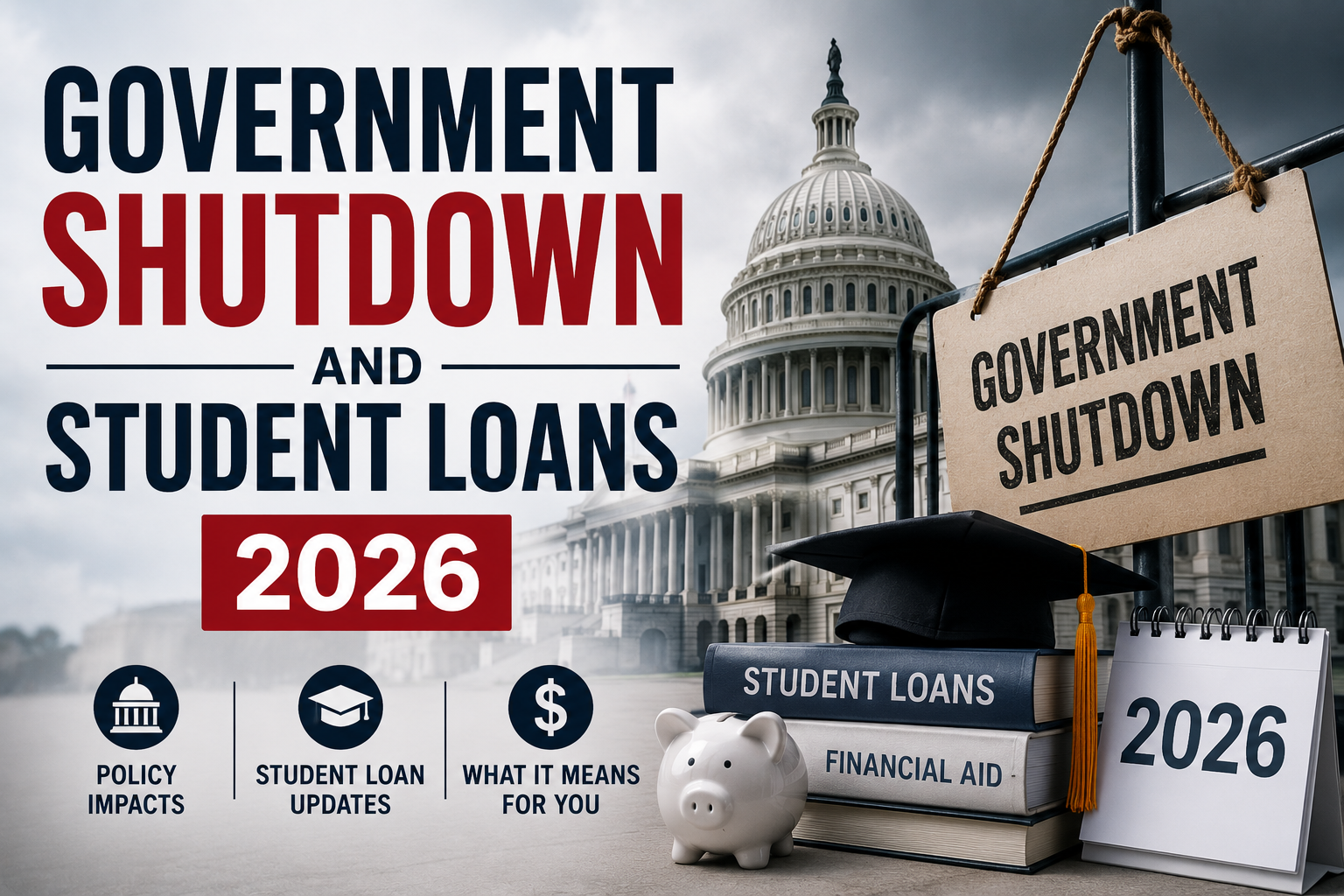
If you have federal student loans, the words “government shutdown” probably make your stomach drop.
And honestly? That reaction is completely understandable.
With Washington’s budget battles continuing to rattle financial markets and federal programs, millions of student loan borrowers are left wondering: Will my loans be affected? Do I still have to make payments? What happens to my forgiveness application?
The good news is that a government shutdown doesn’t mean your student loan world completely falls apart. The bad news? It does create real delays, uncertainty, and headaches — especially if you’re pursuing forgiveness programs or need active support from the Department of Education.
Let’s break it all down clearly so you know exactly where you stand in 2026.
What Is a Government Shutdown, and Why Does It Matter for Student Loans?
The Basics of a Government Shutdown
A government shutdown happens when Congress fails to pass a budget or a continuing resolution to fund federal operations. When that occurs, all “non-essential” government functions are either paused or significantly reduced. Federal employees get furloughed — meaning they’re sent home without pay — until a funding deal is reached.
This affects everything from national parks to food assistance programs. And yes, it affects the U.S. Department of Education too.
How the Department of Education Is Impacted
During a shutdown, the Department of Education doesn’t go fully dark, but it does operate on a skeleton crew. The department plans to furlough approximately 95% of its non-Federal Student Aid staff during the first week of a funding lapse, with around 85% of the Office of Federal Student Aid staff also furloughed — leaving just 115 employees to keep essential operations running.
That’s a drastically reduced workforce managing a student loan portfolio that affects tens of millions of Americans. The ripple effects are significant.
ALSO READ: Best Remote Jobs for College Students in 2026
Do You Still Have to Make Student Loan Payments During a Government Shutdown?
Yes, Payments Are Still Required
This is the question most borrowers ask first, and the answer is clear: student loan payments are still required during a government shutdown.
The Department of Education has confirmed that loan payments continue as scheduled regardless of a funding lapse. The federal student loan system runs on existing approved funding through Federal Student Aid, which means your servicer is still operational and your payment due date doesn’t move.
Missing a payment during a shutdown can still result in late fees, negative credit reporting, and potential delinquency, just as it would at any other time. So don’t assume a shutdown gives you a pass on your monthly bill.
What If You’re a Furloughed Federal Worker?
This is where things get genuinely difficult. If you’re a federal government employee who has been furloughed without pay, you may suddenly find yourself unable to afford your student loan payment through absolutely no fault of your own.
In that case, you have options:
- Request an IDR recalculation: If your income has dropped to zero due to furlough, you can immediately apply for a recalculation of your Income-Driven Repayment (IDR) plan. If you’re earning $0 and filing individually, you may qualify for a $0 monthly payment.
- Apply for deferment or forbearance: Contact your loan servicer to request a temporary pause on payments. Just be aware that periods of forbearance or deferment do not count toward Public Service Loan Forgiveness (PSLF) qualifying payments, so an IDR recalculation is the smarter move for PSLF borrowers.
What Happens to FAFSA and New Financial Aid During a Shutdown?
FAFSA Keeps Accepting Applications
If you’re a student applying for financial aid, there’s some reassuring news: FAFSA applications continue to be accepted and processed during a government shutdown.
The Department of Education has confirmed it will continue to process FAFSA applications using permanent appropriations. The FAFSA for the 2026-27 academic year is live, and students are encouraged to submit as early as possible to maximize their aid eligibility.
Watch Out for These Delays
While the FAFSA stays open, there are areas where a shutdown creates real friction:
- Verification for non-citizen eligibility can be delayed
- Tax transcript requests may be harder to obtain
- New Direct Consolidation Loan applications outside the standard FAFSA process may slow down significantly
- Grant disbursements for certain programs may be delayed until the shutdown ends
The bottom line: submit your FAFSA as early as possible, and don’t wait until the last minute expecting everything to process smoothly.
The Biggest Shutdown Impact: Loan Forgiveness Backlogs
IDR and PSLF Applications Face Major Delays
Here’s where the government shutdown creates the most damage for student loan borrowers — and it’s a problem that’s already playing out in 2026.
The shutdown caused significant delays in processing Income-Driven Repayment (IDR) applications and Public Service Loan Forgiveness (PSLF) buyback applications. After the shutdown ended, the Department of Education reported that over 800,000 IDR applications were still pending, with processing only slowly catching up.
The PSLF buyback backlog actually continued to grow even after processing resumed — meaning borrowers who believe they’ve reached their forgiveness threshold may still be waiting for their discharge.
What This Means for PSLF Borrowers in 2026
If you’re pursuing PSLF, the situation in 2026 requires careful attention:
- New PSLF regulations take effect July 1, 2026, bringing changes to qualifying employer definitions and buyback costs
- Periods of furlough deferment do not count toward your 120 qualifying PSLF payments
- The department expects to resume regular IDR plan checks on an every-other-month basis starting in 2026, but borrowers who qualify for forgiveness may still face delays in receiving their discharge
- If you cross the forgiveness threshold but processing is delayed, the tax date that matters is when you crossed the threshold — not when the forgiveness is actually processed
The SAVE Plan Is Gone — Here’s What Replaced It
Adding another layer of complexity, the SAVE repayment plan was officially terminated by the 8th Circuit Court on March 10, 2026. Borrowers who were on SAVE have 90 days from July 1, 2026 to switch to a qualifying repayment plan — or they’ll be auto-enrolled in the Standard Repayment plan.
The replacement is the new Repayment Assistance Plan (RAP), launching July 1, 2026. Under RAP, the forgiveness tail extends to 30 years (compared to 20-25 under older IDR plans). Borrowers should review which plan makes the most sense for their situation and switch proactively.
What Borrowers Should Do Right Now
5 Smart Steps to Protect Yourself
Given everything happening with government shutdowns and the shifting student loan landscape in 2026, here’s what you should be doing:
1. Know your loan servicer — and keep records of every interaction. With reduced Department of Education staffing, reaching a real person to resolve disputes is harder than ever. Document every call, email, and payment confirmation. Disputes during a shutdown can become nearly impossible to resolve quickly.
2. Don’t miss a payment unless you’ve formally requested forbearance or deferment. Assuming a shutdown means a payment pause is a costly mistake. If you need relief, make it official through your servicer.
3. If your income has dropped, recalculate your IDR payment immediately. This is especially important for furloughed federal workers. A $0 IDR payment still counts as a qualifying payment for IDR forgiveness (though not PSLF). It’s far better than going into delinquency.
4. PSLF borrowers: stay on an IDR plan, not forbearance. Forbearance months don’t count toward your 120 PSLF payments. Reduce your IDR payment to $0 if needed, but stay in the program.
5. Check studentaid.gov regularly. Even during a shutdown, the Federal Student Aid website remains operational. Check your account status, application progress, and servicer contact information there directly.
The Bigger Picture: Why This Keeps Happening
Budget Gridlock and Its Toll on Borrowers
The recurring cycle of government shutdowns isn’t just a political inconvenience — it has real, lasting consequences for student loan borrowers. Every shutdown creates new processing backlogs that take months to clear. Borrowers pursuing forgiveness face uncertainty about whether their applications are moving forward. Federal employees risk their credit scores and loan standing simply because Congress can’t agree on a budget.
Experts have repeatedly noted that the longer a shutdown drags on, the harder it becomes to get back on track once the government reopens. Backlogs compound. Staff return to a mountain of unprocessed applications. Borrowers wait.
Legislation like the HELP FEDs Act — introduced in late 2025 — has proposed protecting federal workers from student loan penalties and interest accrual during shutdowns. But until such protections become law, borrowers are largely on their own.
ALSO READ: Why a Budget Is Important (For Students & Adults)
Final Thoughts: Stay Informed and Stay Proactive
A government shutdown is stressful enough without the added anxiety of student loan uncertainty. The most important thing you can take away from this is simple: don’t assume anything will automatically pause or be forgiven. Payments are still due. Forgiveness programs are still running — just slowly.
Stay proactive, communicate with your loan servicer early, and document everything. In a landscape where government operations can grind to a halt with little warning, being an informed borrower is your best protection.
If you’re unsure how the shutdown affects your specific situation — especially if you’re pursuing PSLF, transitioning off SAVE, or applying for new aid — consider speaking with a certified student loan advisor who can give you personalized guidance.
Your financial future is too important to leave to chance.